
Classic Rock
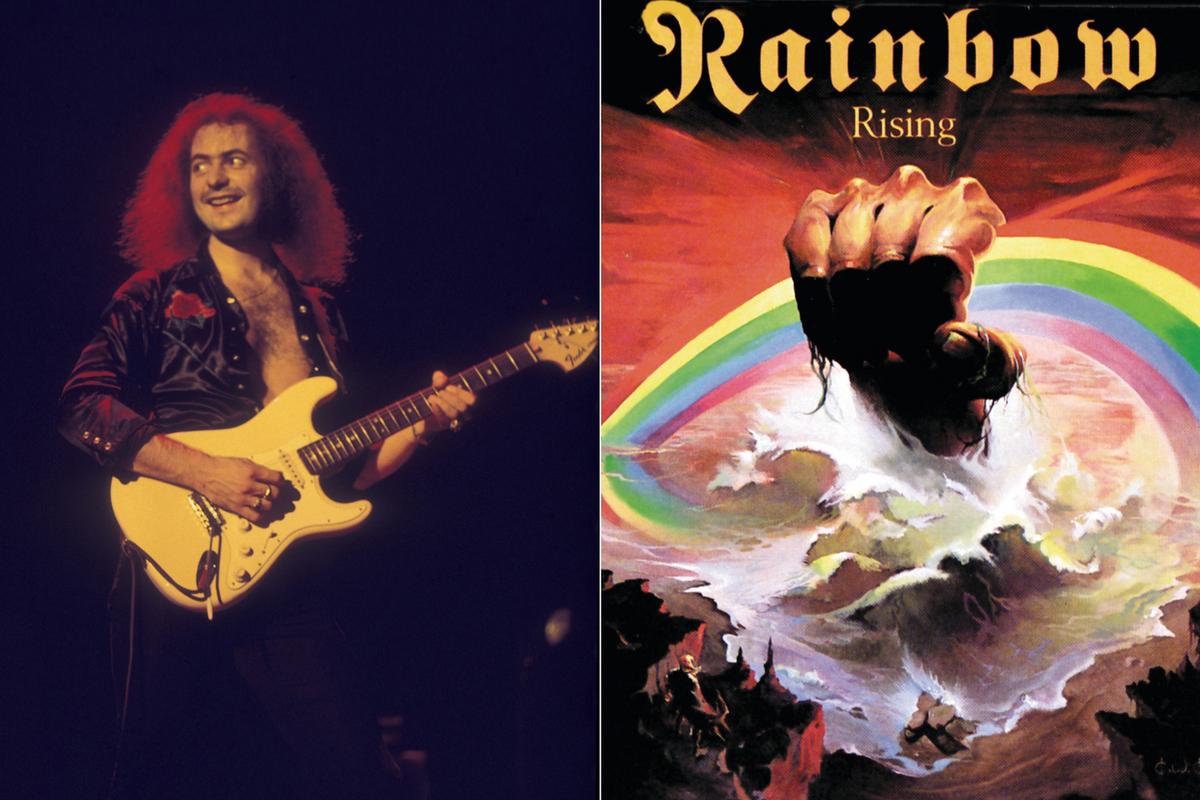
Rainbow’s ‘Rising’ at 50: Ritchie Blackmore Looks Back
May
Ritchie Blackmore’s time with Deep Purple was clearly running out.
As the guitar legend told us in a rare interview, he’d grown weary of being part of the future British hard rock legends’ ongoing musical exploits and the drama that came along with it. He freely admits in the conversation below that he recognized he was part of the problem.
A change seemed like the right move to address the disgust he felt within himself, but at the same point, he was frustrated with his bandmates too.
“When I left Deep Purple, I just felt that the band wasn’t pulling [its weight] as a musical venture,” he explains. “It became a committee. It was like if there were some answers to be had, there were five different answers. And I got a little bit tired of the committee meetings.”
A new box set chronicles what came next for Blackmore, with Ronnie James Dio and the new band the pair assembled, Rainbow. The Temple of the King: 1975-1976 offers a deep dive into the group’s first two albums, 1975’s Ritchie Blackmore’s Rainbow and Rising, which followed in 1976.
Though interviews with Blackmore are scarce these days, he agreed to answer questions, including sharing the story for the first time of why he was replaced on stage for one night in San Antonio on guitar by future soft rock balladeer Christopher Cross.
In the first part of our interview, he detailed his recent health struggles, how he’s feeling now and his departure from Deep Purple. Today, in the second installment, he discusses (often, with a bit of humor and sarcasm) how he moved forward with Rainbow and looks back at the Rising album as it turns 50 this week.
From your point of view, how were you further evolving with these first two Rainbow albums? I would imagine that each one represents a memorable chapter for you personally, as far as what was accomplished, and at the same time, learned.
I don’t believe in evolving. Number one, I don’t really understand the word and I was just uncomfortable. So it was time to move on and do other things. I’d been in Purple, I think, for seven years. And I think I got the feeling that we’d done everything we could do in our type of music. I did notice a lot of egos coming and going, so that was tiring. I just wanted to play music and not have any egos.
The biggest ego of all of them was me, and I was kind of disgusted with myself at the time, so I thought, “I want to move on. I want to be away from myself.” I found that difficult, but David Copperfield helped me out. He said, “I can make you move from yourself and be in the audience at the same time that you’re on stage.” And I said, “Okay, carry on.” So that’s where I went with that. I went to Las Vegas and joined David Copperfield’s crew. He taught me exactly how to be in two places at once, and I paid him handsomely for what he did and that was it.
Listen to Ritchie Blackmore on the ‘UCR Podcast’
How do you think you and Ronnie challenged each other as writers and creatives.
We had a couple of old ceremonial swords, so we went out the back and we fought it out around his house. That’s how we challenged each other. But realistically, challenging never came into the equation. We always got along very easily. It was very easy to write with Ronnie, because he was been a trumpeter in an orchestra. So he was very musical. Sometimes at rehearsals, he would say to me, “What are you hearing in this?”
I would go up to him and as we were all playing as a band, I would kind of hum or whisper in his ear what I thought maybe the idea [could be]. And he instantly got the idea of where I was going and that’s how we made most of our music. He was very quick to write lyrics, although I never really understood some of the lyrics. And I would ask him, “What’s ‘Man on the Silver Mountain,’ What’s that?” And he would go, “I don’t really know, [it’s] just something I thought of as a spur of the moment [thing].” Which, you know, I think everybody has their own silver mountain that they can pretend to have so sometimes lyrics don’t have to make perfect sense.
Listen to Rainbow’s ‘Man on the Silver Mountain’
Okay, what did you appreciate about what Ronnie brought to your music?
Working with Ronnie was very easy. When we first put down a couple of songs on a recorder that we had, he wasn’t singing the usual heavy metal song. What he was singing, it was like renaissance, a 1500 kind of melody, to a lot of the ideas I had, which I was very impressed with his interpretations.
He was obviously a very clever guy and it never took him more than 10 minutes to come up with something as far as the melody goes, although sometimes I would give him a melody in which he would use. But he was very quick on the uptake. I think, Ronnie, in his own way, it’s kind of strange. Because I think he would spend more time watching baseball than he would actually writing a song. Because he could write a song so quickly that he would write it in 10 minutes and then go back to his baseball, which he loved.
So that’s it was very easy to write with him, and there was so much continuity. Immediately, he seemed to know what page I was on when I was trying to come up with certain ideas, and I hadn’t really had that took me the towards the end with purple, there was a lot of discontent and a lot of scattered thinking, and very difficult to get everybody together in the same room. So it was such a pleasure just to be able to sit with a guitar play something, and the man knew exactly where I was going with it, and I really didn’t have to do much coaxing or helping him, because he basically helped himself. He was a magical guy,
READ MORE: How Ritchie Blackmore Plans to Play Live Again
Overall, what are some of the moments that really stick with you about recording that first Rainbow album?
Doing the first Rainbow album was tricky in a way, because I had nothing worked out, hardly. I didn’t know what I was doing. I didn’t know where I was going. And at the time, there was a lot of different people involved with the management side of things, so everything was very tricky.
So I was just glad that I could put down, I think it was 10 or 11 songs and I think a couple of the songs were good and I think a couple of the songs were a bit weak. But I did it, I think, in that three weeks. So it was something that I had not thought through properly. I just played whatever came to mind at the time and I didn’t quite know what style I even wanted to play. That’s why some of it’s very melodic and some of it’s very heavy. I was torn in between the two type of styles. If you believe that, you’ll believe anything.
Listen to Rainbow’s ‘Stargazer’
It seems like the shows the band played in the last half of 1975 were an important driver that influenced material and ideas for Rising in a pretty interesting way.
Well musically, that period, I was becoming comfortable in my own skin. The second time we approached stuff for Rainbow, I knew more or less where I was going, which was more heavy, but yet with an accent on melody. So as opposed to the first record, which I really didn’t have much of an idea what I wanted to do, the second one, I was much more adamant about what I personally wanted to get across, especially with things like “Stargazer” and heavier songs.
Ronnie was [also] coming into his own with his tone and his way of thinking, because, like I said before, we were both heavily into light kind of music in the beginning, but then when Rising came along, we were turning into a very heavy rock band, which I didn’t mind at all . Because that’s one of the styles I love to play. And obviously Ronnie was on board with that style too.
Cozy [Powell] was always a heavy hitter, so he was the right guy for us at the time. We went our merry way, which was down the hard rock road. And I was feeling much more comfortable with being in a studio, without being in the studio with [Deep] Purple. This is the second record that I made with other other members and other musicians, so I was getting kind of used to being in the studio and feeling more comfortable than I was in the beginning.
READ MORE: How Rainbow Redefined Heavy Metal With ‘Rising’
The live shows in this box set are special to have. You’d gotten to do your share of improvisation with Deep Purple, but looking at the variety each night with the three shows here, it feels like you had a blank canvas each time you stepped on stage.
On stage, which is my favorite place to be. I do like to improvise. And I do like to play certain songs different ways, which confuses everybody. But I do like playing games and almost playing one song differently every night, so that it keeps people on their toes, including myself. I would say that what drove a lot of the nights,
I know what it drove me was it drove my anger. I seem to be very angry on stage [through] that music that we were playing, I kind of opened up that kind of corridor of thought that it was anger that we were expressing to the audience, and the audience was picking up on it, because I could tell that people in the audience, they were angry too, although they loved it. It was an escape valve for everybody’s anger.
So a lot of Rainbow songs relied on this angry interpretation, which the guy who did the nine to five job in the audience with the denim jacket, he was angry too. So we were all in unison and sympathetic to each other, that we were all [fed up with how we were being treated] by people and and how angry you can be, and it’s just a way of getting that anger out which, which I did every time I came on stage. You know, it was a great release for me,
But Cozy was pretty angry. I was angry and Ronnie was angry. With three angry guys, [we were] kind of pushing to express our music that we felt wasn’t being heard enough on the radio, because the radio was playing all schmaltzy kind of stuff, especially in England.
It was quite interesting how they would not really go near our stuff. We were considered too heavy and too loud and too aggressive, but we enjoyed it. And of course, we were playing to packed houses, so I assumed there was a lot of angry people out there that enjoyed our anger.
19 Rock Guitars That Were Stolen or Lost (and Sometimes Found)
Some of these are still out there somewhere.
Gallery Credit: Allison Rapp
