
Classic Rock
The ‘Big 4’ of Rock Collaborations
Nov
You never know what you’re going to get when rock’s biggest stars team up.
On paper, great collaborations seem easy. Put already-established stars together, let them combine their musical magic, then watch as they churn out an unforgetable hit. In reality, the process is far more complex. Every musician has their own unique approach to songwriting, so collaborations come with serious potential for a creative clash. Then you have to factor in egos — whereas bands often have a clear alpha in their structure, collaborations often bring together two or more artists who are used to getting their own way.
Yes, a successful collaboration is far from guaranteed, but when the right musicians join forces, the result can be phenomenal. Below, we’ve put together our Big 4 of Rock Collaborations.
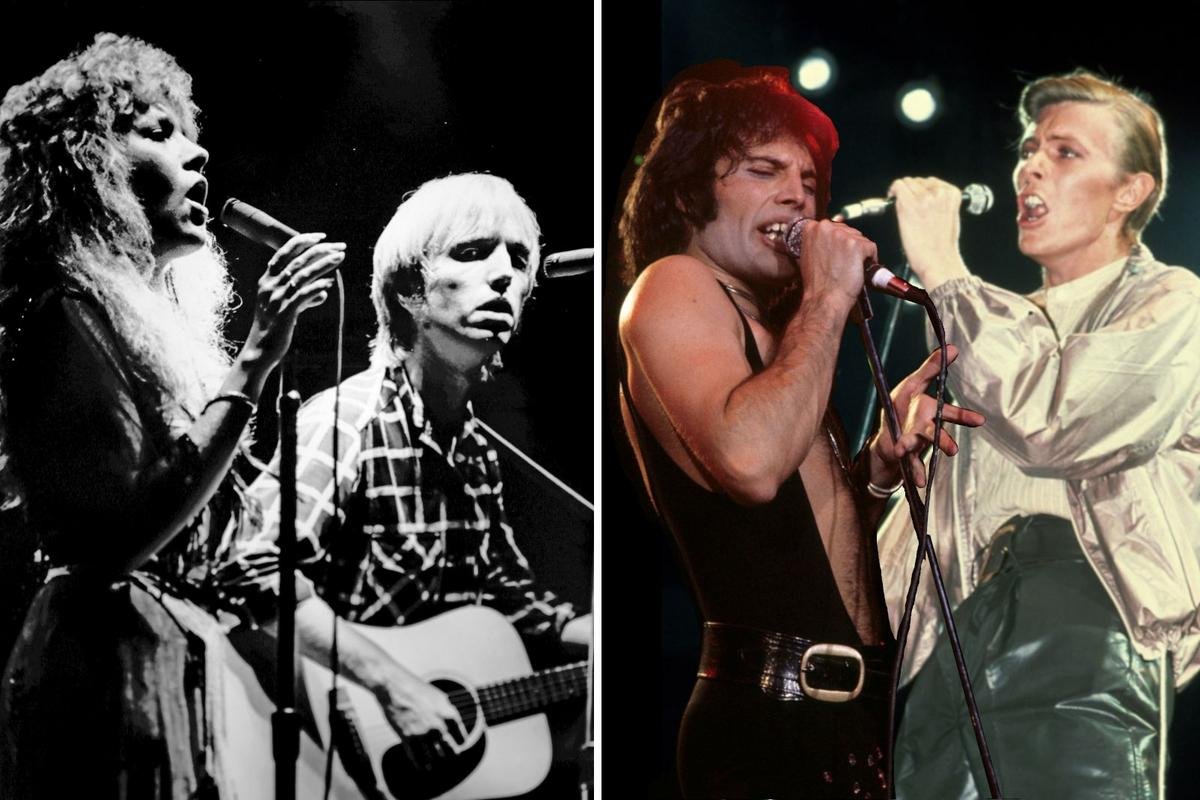
Queen and David Bowie, ‘Under Pressure’
Like many great collaborations, “Under Pressure” wasn’t planned – it just came about naturally. The track was initially written during the summer of 1981. Queen was working on a project in Montreux, Switzerland, where David Bowie happened to have a residence. The Ziggy Stardust singer stopped by to say hello and quickly the musicians began jamming. Soon, Bowie suggested writing a song together, which they did over copious amounts of wine.
“We went in there with a clear canvas, David and the four of us, and kicked around a few riffs and things, and that was one of the things we came up with,” Queen guitarist Brian May recalled to Ultimate Classic Rock Nights. A bass idea brought forth by John Deacon sparked inspiration. Soon, Bowie was encouraging the rockers to come up with lyrical ideas.
“The vocal was constructed in a very novel way, which came through David, because he had experience of this avant-garde method of constructing the vocals,” May noted. “He said, ‘Everybody just goes in there with no ideas, no notes, and sings the first thing that comes into their head over the backing track.’ So we all did, and then we compiled all the bits and pieces – and that’s what ‘Under Pressure’ was based on; all those random thoughts.”
The next day, Bowie took stronger artistic control – something the members of Queen likely would have bristled with had it not been David Bowie.
READ MORE: The Best Song From Every Queen Album
“David was in there first and told us he wanted to take the track over, because he knew what he wanted it to be about,” May told the Mirror. “We all backed off, and David put down a lyric which now focused on the ‘Under Pressure’ part of the existing lyric. It was unusual for us all to relinquish control like that but, really, David was having a genius moment – because that is a very telling lyric.”
Despite the obvious appeal of “Under Pressure,” it seemed for some time that the track would never get released. Discourse surrounding the mix left both Bowie and Queen frustrated regarding the final product. Thankfully, wiser heads (and calmer egos) prevailed.
Released Oct. 26, 1981 “Under Pressure” became a global hit. With Bowie and Queen at their grandiose best, the song became a testament to rock’s power. Decades later, it is still regarded as one of the greatest collaborations in music history – the only tragedy is that Bowie and Queen were never able to perform it together live.
Aerosmith and Run DMC, ‘Walk This Way’
Initially, Run DMC had no interest in rapping over an Aerosmith track. At the time, the trio was one of hip-hop’s hottest acts, while Aerosmith was mired in one of the deepest commercial ruts of their career. Still, producer Rick Rubin heard something that could link the two acts.
“I went through my whole album collection looking for a song that Run-D.M.C. could do that would point out the relationship between hip-hop and other kinds of music,” Rubin told VH1. “‘Walk This Way’ had a familiar rock sensibility to it, but at the same time, with very little change, would function as a hip-hop song.”
Originally released on 1975’s Toys in the Attic, “Walk This Way” had already served Aerosmith well. The single became a Top 10 hit and was part of the band’s impressive run in the ‘70s. Could Run DMC turn it into a hip-hop hit more than a decade later?
READ MORE: Top 15 ’80s Aerosmith Songs
“We heard … hillbilly gibberish,” Darryl “DMC” McDaniels remembered thinking when he heard the song, admitting he was against the collaboration. “Me and Run thought [label head] Russell [Simmons] and Rick were trying to ruin us.”
Interestingly, it was Aerosmith’s Joe Perry who helped bring both sides together. The guitarist’s son had played him some of Run DMC’s music, and he liked what he heard. So when Rubin called in an attempt to get the artists in the studio together, Perry was quickly on board (and convinced Steven Tyler to join him).
“We walk in, and Joe Perry is playing his riff, Steven Tyler is in the booth doing the lyrics,” McDaniels recalled, describing the moment Run DMC stepped into the studio with Aerosmith. “Me and Run knew we had to step our game up. Jay was like, ‘Yo, don’t think of the record as ‘Steven Tyler and Joe Perry’s record,’ think of those lyrics as Run DMC lyrics.’ So we went in the booth and that went so good that Steven said, ‘Yo, let me get in with y’all’.”
The collaboration proved electric. Released as the second single from Run DMC’s 1986 album Raising Hell, “Walk This Way” became a landmark song in the history of both rock and hip hop. The genre-bending track became a Top 10 hit, while its iconic music video earned heavy rotation on MTV. For Aerosmith, it also marked a major career comeback – the momentum of “Walk This Way helped propel the band back into the spotlight for an impressive run of ‘80s hits.
Stevie Nicks and Tom Petty & the Heartbreakers, ‘Stop Draggin’ My Heart Around’
Stevie Nicks was a huge admirer of Tom Petty’s and had routinely asked the rocker to write a song with her. Whether she was being serious or playful depends on who you ask.
“It was her mission in life that I should write her a song,” Petty recalled in Conversations with Tom Petty. “I almost preferred the Heartbreakers’ music to Fleetwood Mac’s music at that point,” Nicks confirmed in the documentary Runnin’ Down a Dream. “So I called Jimmy Iovine and asked him if he would consider producing my first solo record. I thought maybe this is the way to get that Tom Petty and The Heartbreakers sound. And I wanted to be friends with Tom, and friends with the Heartbreakers.”
Initially, Petty gave her a tune called “Insider,” but after recording a demo of the track, he opted to keep it for his 1981 album Hard Promises. When Iovine – who was producing for both artists at the time – heard an early version of “Stop Draggin’ My Heart Around,” he suggested that it could be a better option for Nicks.
READ MORE: The Best Song From Every Tom Petty Album
“I wasn’t used to doing other people’s songs, so I didn’t really like the idea at first,” Nicks recalled in liner notes to her TimeSpace compilation, slightly contradicting Petty’s recollection of the situation. “But I loved Tom Petty, so I agreed to try. So we went into the studio and sang it live, together. I was completely entranced, and I instantly fell into love with the song.”
The track Nicks sang over the original Heartbreakers recording, a fact that initially displeased Petty, who would have preferred the whole thing be re-recorded. “Jimmy, you just took the song…,’” Petty recalled complaining to Iovine. “His comeback was like: ‘This is gonna buy you a house.’”
Sure enough, “Stop Draggin’ My Heart Around” worked wonderfully as a duet, with Nicks’ and Petty’s distinctive voices capturing the song’s theme of a complicated romance. It became the lead single to Nicks’ debut solo album, 1981’s Bella Donna, and peaked at No. 3 on the Billboard Hot 100. It remains the highest chart success for both the Heartbreakers and Nicks’ (as a solo artist).
Peter Gabriel and Kate Bush, ‘Don’t Give Up’
We could have easily given the final spot in our Big 4 to the classic grunge collaboration “Hunger Strike,” but we opted to go in a different direction.
With Peter Gabriel’s powerful voice blending perfectly with Kate Bush’s ethereal tones, “Don’t Give Up” was an emotive triumph. Still, it took several twists of fate to reach its final version.
The song’s inspiration came from images of families suffering during the Great Depression-era Dust Bowl. Gabriel saw similarities between those struggles and the economic plight facing families in England at the time. On another level, concepts of depression, hope and determination resonated with the singer, who at the time was suffering with his own mental health.
Initially, Gabriel wrote and recorded the song for his own, singular voice. However, listening back he realized it needed deeper contrast. He decided the tune should become a duet, and originally a different female singer was offered the part.
READ MORE: How Peter Gabriel Conquered the World with ‘So’
“There was a reference of America roots music in it when I first wrote it, it was suggested that Dolly Parton sing on it,” Gabriel revealed in 2011. “But Dolly turned it down… and I’m glad that she did because what Kate did on it is… brilliant.”
Gabriel handled the verses, echoing themes of struggle and isolation, while Bush provided the chorus’ uplifting message of support. The dichotomy worked beautifully, and resonated with listeners across the globe and “Don’t Give Up” became one of the many highlights on Gabriel’s 1986 album So.
“The sensitive treatment Kate gave our give-and-take on that song was gratifying, because it’s not just a song about a woman supporting a man in a demanding relationship,” Gabriel told Spin in 1986. “The chief thing dragging them down is unemployment, which is presently tearing the social fabric of Thatcher’s England apart… Without a climate of self-esteem, it’s impossible to function.”
Rock’s 100 Best ’80s Albums
Music in the ’80s is typically associated with the neon-tinged synthpop of MTV’s early era, but there was much more to this wildly varied decade.
Gallery Credit: Nick DeRiso
