
Classic Rock
How a Conservative Republican Made Woodstock Possible
Aug
In 1970, Joni Mitchell sang about Woodstock, even though she didn’t perform at or attend the festival: “I’m going on down to Yasgur’s Farm / I’m gonna join in a rock and roll band / I’m gonna camp out on the land / I’m gonna try and get my soul free.” Crosby, Stills, Nash & Young, who did perform at the festival, made Mitchell’s song famous with their cover version.
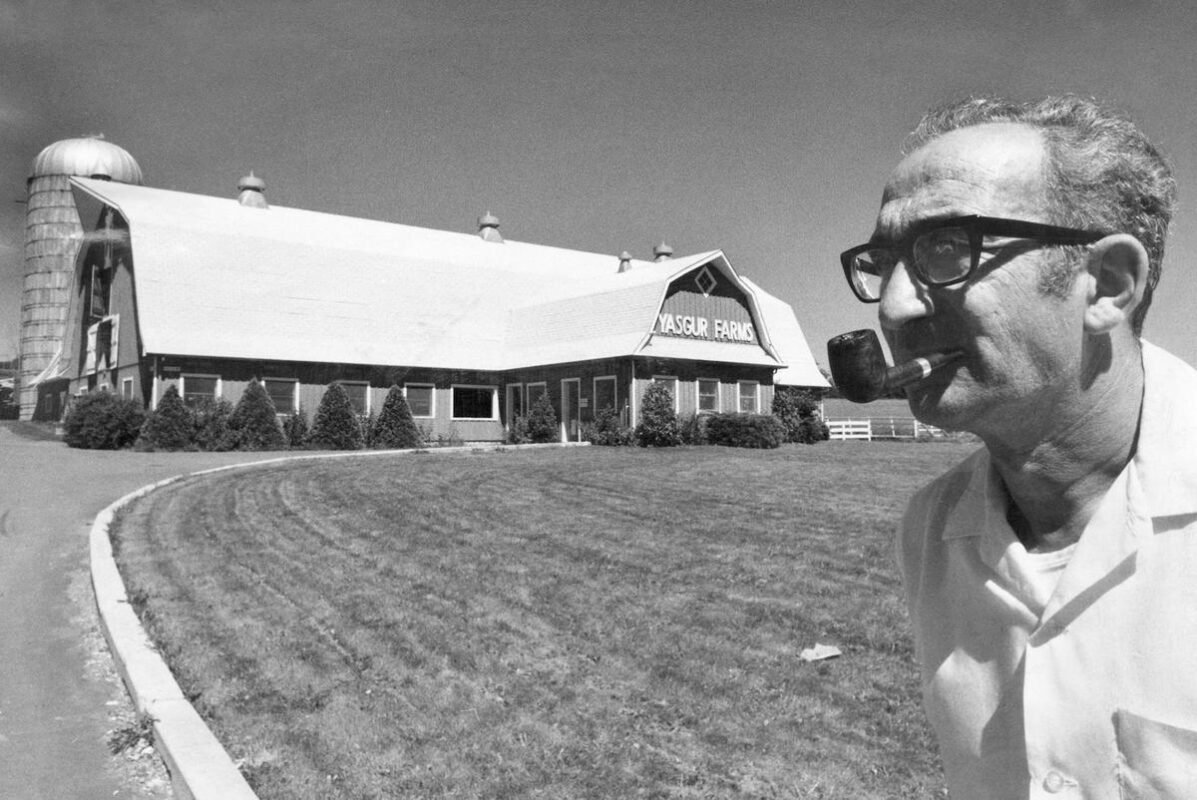
Mitchell’s song namechecked the man that Woodstock could not have happened without, a 49-year-old farmer named Max Yasgur who owned a 600-acre dairy farm in Bethel, New York, just a few hours north of New York City.
The son of Jewish immigrants, Yasgur spent time in and out the city — he grew up on the family farm upstate, but also attended New York University in Manhattan for real estate law. After school, Yasgur moved back to the family farm, which was ultimately sold just a couple years later. But Yasgur had no intention of slowing down business.
He picked up and moved things to Bethel, where his operation turned into the largest milk producer in Sullivan County, boasting what were then state-of-the-art facilities.
But then came Woodstock.
The Original Woodstock Site
The Woodstock Music and Art Fair, conceived by Michael Lang, Artie Kornfeld, Joel Rosenman and John P. Roberts, was initially planned for the town of Woodstock itself, but local residents opposed the idea. Saugerties was another option, and then Walkill, where $10,000 was put down and plans moved ahead under the condition that no more than 50,000 people would attend the event. But again, residents protested and a law was subsequently passed that required a permit for any gathering of over 5,000 people. Moving ahead in Walkill was effectively made impossible.
Yasgur got wind of this and took a different perspective. Ironically, as it would be learned in later years, Yasgur was a conservative Republican who reportedly supported the Vietnam War — the polar opposite of Woodstock’s message — and yet he recognized an opportunity.
Listen to CSNY’s Version of ‘Woodstock’
For one thing, hosting a huge event could potentially bring in more business to the farm. But from a more principled standpoint, Yasgur felt that the people running Woodstock should be afforded the chance to organize how they wanted. Once again, local residents weren’t thrilled with what they saw to be an invasion of long-haired, draft-dodging hippies.
According to the Woodstock preservation archives, a sign popped up in town: “Don’t Buy Yasgur’s Milk. He Loves the Hippies.”
“The sign did it,” Yasgur’s wife Miriam Yasgur recalled. “When Max saw that, I knew darned well he was going to let them have their festival. You didn’t do that to Max.”
At a town board meeting, Yasgur pushed back hard.
“I don’t particularly like the looks of some of those kids either,” he reportedly said, according to his son Sam’s book, Max B. Yasgur The Woodstock Festival’s Famous Farmer. “I don’t particularly like their lifestyle, especially the drugs and free love. And I don’t like what some of them are saying about our government. However, if I know my American history, tens of thousands of Americans in uniform gave their lives in war after war just so those kids would have the freedom to do exactly what they are doing. That’s what this country is all about and I am not going to let you throw them out of our town just because you don’t like their dress or their hair or the way they live or what they believe. This is America and they are going to have their festival.”
READ MORE: 15 Woodstock Artists Look Back at the Historic Festival
Yasgur doubled down even further: “What are you planning to do next? Are you going to try to throw me out of town because I am a Jew?”
That just about settled the matter. Woodstock would take place Aug. 15 to Aug. 18, 1969 on Yasgur’s property.
Yasgur’s Woodstock Speech
As we know, the total attendance at Woodstock far exceeded the aforementioned 5,000 that Walkill had intended to keep it to — it’s estimated that between 400,000 and 500,000 people turned up over the course of those few days.
“I never expected this festival to be this big,” he said then, via The New York Times. “But if the generation gap is to be closed, we older people have to do more than we have done.”
Yagur even offered free food and was upset when he found out some local residents were selling water to concert-goers. “How can anyone ask for money for water?” he said then.
READ MORE: 55 Years Ago: Woodstock by the Numbers
Yasgur was reportedly paid $50,000 by the festival’s sponsors to rent the farm, but the money was clearly only a part of why he hosted Woodstock. At the third day of the festival, he took the stage himself to address the crowd.
“I’m a farmer,” Yasgur said (via The Forward). “I don’t know how to speak to 20 people at one time, let alone a crowd like this. But I think you people have proven something to the world — not only to the Town of Bethel, or Sullivan County, or New York State; you’ve proven something to the world…a half million young people can get together and have three days of fun and music and have nothing but fun and music, and I — God Bless You for it!”
Watch Max Yasgur Take the Stage at Woodstock
Naturally, Yasgur’s choices burned bridges with some of his neighbors — he was even sued in 1970 for property damage. Yasgur eventually sold the farm in 1971, moved to Florida and died there two years later at age 53.
He did harbor some regret.
“The worst thing about Woodstock was that there were just too many,” he reportedly said in 1971, also noting his dislike for the drug usage. “I wouldn’t have done it if I knew there were going to be half a million instead of 40,000. … Bethel is a rural town and can’t service a crowd that big. … I have no right to have any kind of affair that would block vital services from reaching my neighbors.”
READ MORE: Top 10 Woodstock Performances
In the end, Yasgur’s precise political opinions didn’t matter.
“He was a Republican, he was pro-Vietnam War, he was the antithesis of everything we stood for,” promoter Michael Lang said to the Washington Examiner in 2009. “He was our hero.”
What counted was his strong will and belief in the idea that ordinary people deserved the right to be themselves. He once said to his wife: “When I decide that I have to drive by someone in need of help and not stop, that’s not the kind of world I want to live in.”
10 Stars Who Didn’t Play Woodstock – And Why
Among them was old-timey TV cowboy Roy Rogers. Reason: He hated the idea.
Gallery Credit: Nick DeRiso
