
Classic Rock
The ‘Big 4’ of Eagles Albums
Jun
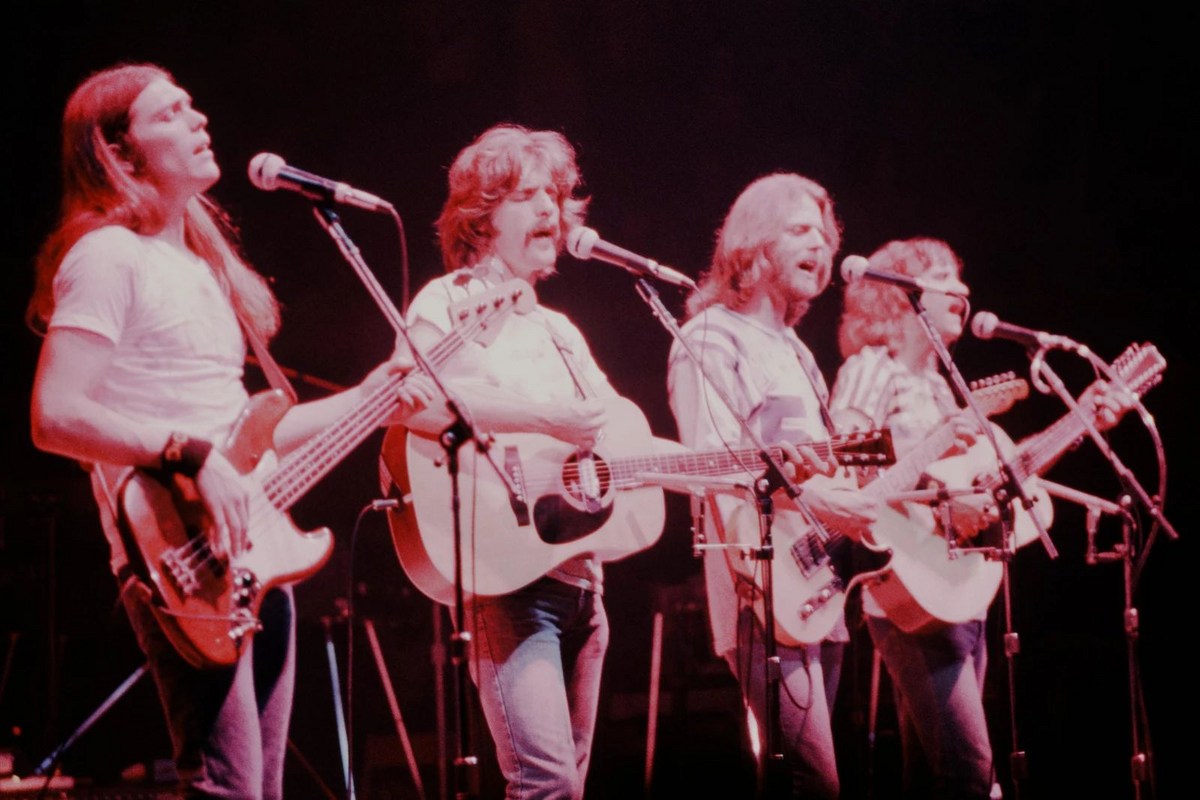
The Eagles‘ classic era didn’t last long. But over the eight years between 1972-79, they released six albums. Every one of them was eventually certified platinum or multi-platinum.
From the first, the band’s core was Glenn Frey and Don Henley. They were originally joined by Bernie Leadon and Randy Meisner, both of whom made important contributions in the Eagles’ more country-leaning early days. JD Souther and Jackson Browne were key songwriting contributors, too.
Their lineup – and producer – changed as the Eagles moved toward a harder-edged rock-infused sound. Leadon and then Meisner departed as Don Felder joined in the mid-’70s followed by Joe Walsh one album later. Ironically, Timothy B. Schmit ended up replacing Meisner, just as he had earlier in Poco.
Looking Back at the Most Important Eagles Albums
The decade-closing configuration of Felder, Frey, Henley, Schmit and Walsh would only make one album before the Eagles split. By then, the Eagles had notched five Billboard No. 1 singles and five other Top 10 hit songs. A 1976 compilation, Their Greatest Hits (1971–1975), went on to four-times diamond certification, representing more than 40 million units sold in the U.S. alone.
For a while, that seemed to mark the end of things, as Frey, Henley and Walsh found solo success. But then their most recent lineup made a surprise return with 1994’s humorously named Hell Freezes Over, which included four new songs. Henley’s “Get Over It” reached the Top 40 while the Schmit-sung “Love Will Keep Us Alive” topped the adult-contemporary charts.
The Eagles released seven studio albums between 1972 and 2007. (Asylum / ERC)
The good times wouldn’t last, however, as Felder was forced out by the end of the decade. Now a four-man band again, they added a new song to 2003’s The Very Best Of and then rallied four years later for a double-album release. The Eagles scored four more Top 20 adult-contemporary hit singles.
READ MORE: How the Eagles Became the First Band to Go Platinum
After that, the Eagles settled into a regular touring schedule that continued even past the sudden death o Frey in 2016. They returned to the road with an updated group that included country star Vince Gill and Frey’s son Deacon, but no other albums followed.
Which of those seven total original studio projects continues to resonate, even decades later? Here’s a look at the ‘Big 4’ of Eagles albums:
‘On the Border’ (1974)
As the Eagles struggled to free themselves of a country-rock trap of their own devising, they ditched their producer. “You are not a rock and roll band,” the departing Glyn Johns memorably told them. “The Who is a rock and roll band, and you’re not that.”
Well, not yet. But the arrival of Bill Szymczyk and soon-to-be-member Don Felder, though only for one song from On the Border, pointed in a new direction. “We had more freedom in the studio with Bill,” Glenn Frey said of Szymczyk, who’d just produced fellow future member Joe Walsh’s album The Smoker You Drink, the Player You Get.
The results are predictably transitional, but they point to everything that would soon make the Eagles superstars: “Already Gone” rumbled with a jaundiced grit, while “Best of My Love” – the first of the group’s five No. 1 singles – was a masterpiece of world-weary ardor.
Listen to Eagles’ ‘Best of My Love’
‘One of These Nights’ (1975)
Many of the songs from One of These Nights were written in a home Glenn Frey and Don Henley shared in Beverly Hills – including the hit title track, “Take It to the Limit” and “Lyin’ Eyes.” They tended to reflect the troubling era around them.
“We thought, ‘Well, how can we write something with that flavor, with that kind of beat, and still have the dangerous guitars?'” Henley later told Cameron Crowe. “We wanted to capture the spirit of the times.”
For any other band, the results would be a career-defining moment. There was another chart-topping song in “One of These Nights,” one of the LP’s three Top 5 singles; a Grammy win for “Lyin’ Eyes” – and four million in U.S. sales alone. But a tectonic shift away from their rootsy beginnings (confirmed here, but still incomplete) wasn’t without its own consequences.
They’d soon see the departure of founding member Bernie Leadon. Then Randy Meisner, who voiced “Take It to the Limit,” split, too. These changes tend to relegate One of These Nights to a sort of preamble status. (We now know what came next in Hotel California.) But these remain some of the Eagles’ best-realized songs.
Listen to Eagles’ ‘One of These Nights’
READ MORE: Ranking Every Song From Eagles’ Game-Changing ‘One of These Nights’ LP
‘Desparado’ (1973)
A one-topic expansion of everything they tried to do on their eponymous debut, the Old West-themed Desperado is an often-overlooked project that just gets better with age.
“It has its moments where it definitely draws some parallels between rock and roll and being an outlaw,” Glenn Frey admitted at the time. “Outside the laws of normality, I guess. I mean, I feel like I’m breaking a law all the time. What we live and what we do is kind of a fantasy.”
Such an ambitious concept didn’t necessarily equal chart success. In fact, this album had no hits, despite later radio play for its title track (which was never released as a single) and “Tequila Sunrise” (which limped to No. 64).
Then there’s the back cover, which shows producer Glyn Johns towering over our tied-up outlaws. That image would prove to be all too metaphorical. As satisfying as Desperado no doubt was, the band quickly came to feel trapped in its cowboy clothes.
Listen to Eagles’ ‘Tequila Sunrise’
‘Hotel California’ (1976)
The familiar title track heralds an epic meditation on gluttony and greed, one that’s eventually underscored on devastatingly frank deep cuts like “Wasted Time” and “The Last Resort.” “They’re the same themes that run through all of our work,” Don Henley told Rolling Stone.
He listed “loss of innocence, the cost of naivete, the perils of fame, of excess; exploration of the dark underbelly of the American dream, idealism realized and idealism thwarted, illusion versus reality, the difficulties of balancing loving relationships and work, trying to square the conflicting relationship between business and art; the corruption in politics, the fading away of the ’60s dream of ‘peace, love and understanding.'”
In the end, Hotel California became a concept album every bit as complete as Desperado, but with a distinctly modern edge. Credit, in part, goes to the addition of Joe Walsh, who acted like a final ingredient in what was becoming a combustible new era for the Eagles.
He tangled brilliantly with Don Felder, while adding an every-man sensibility to Henley’s meditations on post-modern decline amid the coke-addled hellscape that Los Angeles had become for these guys. In the end, the Walsh co-written “Life in the Fast Lane” would serve as the kind of winking summation they’d never been capable of before.
Listen to Eagles’ ‘Hotel California’
The Best Song From Every Eagles Album
Which ones go the distance?
Gallery Credit: Nick DeRiso
Listen to Don Felder on the ‘UCR Podcast’
