
Classic Rock
What Are the ‘Big 4’ of Rock Guitar Solos?
Jun
Choosing the Big 4 of guitar solos? Provocative is one word for the task. Thankless is another.
As we know, most any rock song worth its salt has a guitar solo. That means there are hundreds of thousands, maybe even millions, of them out there. Even on the most elite, iconic level there are scores of candidates. That means making a list and checking it…exponentially. This is one of those situations where you could come up with dozens of four-packs, all with different songs, and still be correct in your selections.
So what makes a guitar solo great? Musicianship and technique, of course. A discernible attitude as well — a personality that comes through in the choice of notes and dynamics that makes it feel like it could come from that player, and only that player.
When the components come together in the right way, the solo is something that elevates the songs even above their melodies and hooks and advances the forms of songwriting, playing and arranging. You can hum the very best as easily as you can the tune of any given song, and you can air-guitar them note-for-note, and with abandon.
Some criteria we employed in the decision making…
* No instrumentals. That’s a whole other category — maybe a future Big 4? — and a different charge for the guitar throughout those compositions.
* No live versions. We stayed with studio creations, solos that were part of the composing process rather than the expanded six- (or sometimes seven-) string excursions they became on stage. So, sorry “Free Bird.”
* Longer isn’t necessarily better. The great solos need to take some time to say their piece, but the real impact is in what’s played, not how long.
Even with those caveats, the legion of applicable solos is massive and unwieldy — but a helluva lot of fun to listen to while making these considerations. So after a lot of thought, and throwing a little bit of caution to the wind…
“Johnny B. Goode,” Chuck Berry (1958)
Danny Cedrone established a rock ‘n’ roll guitar solo template on Bill Haley & the Comets’ “Rock Around the Clock” four years earlier, but Chuck Berry took the concept to another level on his fifth Top 10 and first platinum single.
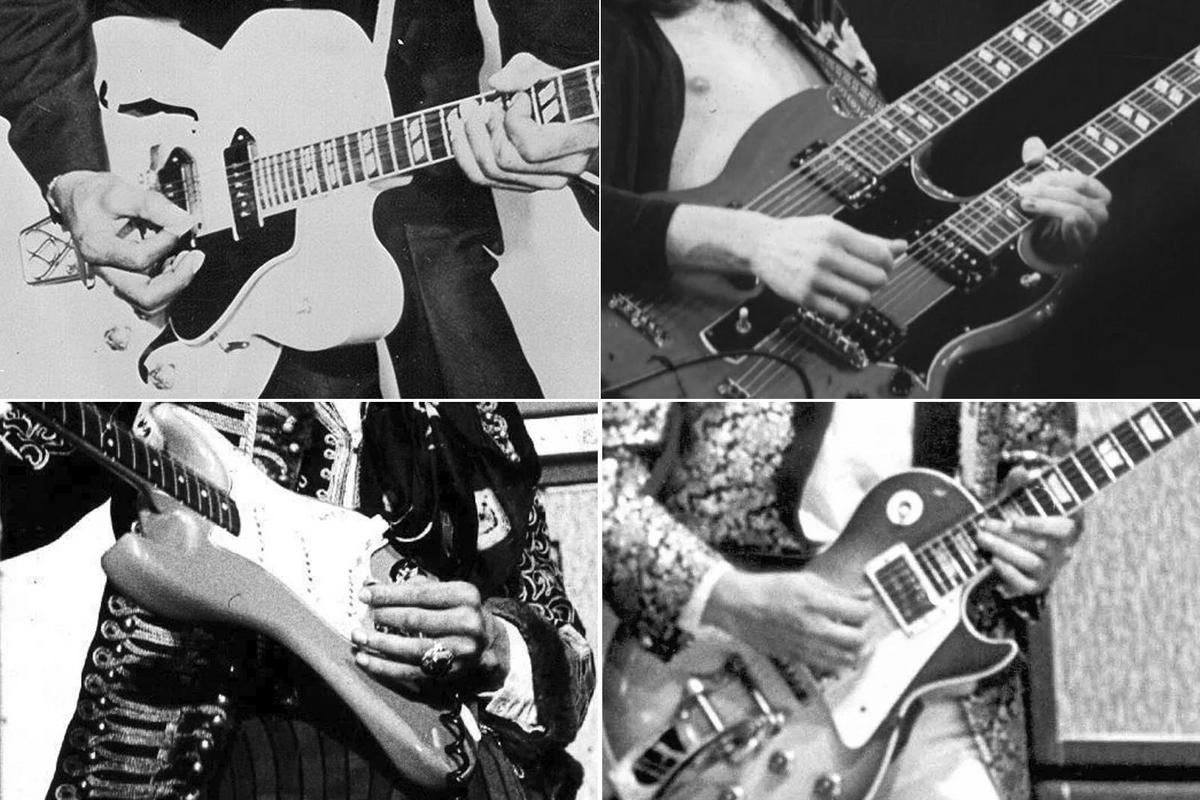
Berry indeed played his guitar — a Gibson ES-350T — just like ringin’ a bell on the track, which was produced by brothers Phil and Leonard Chess at their Chess Records studio in Chicago.
Built atop a pattern created by Berry pianist Johnnie Johnson (Lafayette Leake played on the session, however), Berry kicks off “Johnny B. Goode” with a riff drawn from Louis Jordan’s 1946 song “Ain’t That Just a Woman,” playing a straight-time rhythm against the swinging backup from the band — which included Willie Dixon on bass.
The riff recurs between his vocal lines throughout the song and forms the basis for the 30-second solo itself, with Berry making two passes before hitting the final verse.
Berry had displayed his guitar chops before this, of course, on songs such as “Maybellene,” “Roll Over Beethoven” “School Days” et al, but “Johnny B. Goode” provided an undeniable and enduring reference point for impactful soloing. Just ask Keith Richards…
“Voodoo Child (Slight Return),” Jimi Hendrix Experience (1968)
Coming up with a Big 4 of Jimi Hendrix solos alone is a task unto itself, but this closing track from Electric Ladyland, the third and final album by the Experience, is a world unto itself.
We know we’re headed for guitar nirvana from the wah-wah laced get-go; it’s more than a minute before Hendrix starts singing, preferring instead to unleash an assault of licks and fuzz before he starts singing almost — almost — as an afterthought.
The improvisational approach is, in fact, genuine; building from “Voodoo Chile,” which Hendrix had recorded the day before while jamming with Traffic‘s Steve Winwood and the Jefferson Airplane’s Jack Casady, “Voodoo Child” was created in front of ABC cameras that were filming a documentary.
Bassist Noel Redding and drummer Mitch Mitchell learned the song on the floor and held on for dear life as Hendrix executed six-string acrobatics on his Fender Stratocaster — for nearly a minute on the first solo and a dizzying 93 seconds at the end of the song, screaming and then returning to an earthy root before soaring once again, redefining the idea of overdrive amidst wails of feedback.
Its seeming randomness makes Hendrix’s execution that much more jaw-dropping, and his playing on “Voodoo Child” is among the most intensely analyzed and dissected performer of his or most any other axeman’s career. It was released as a single after his death in 1970 and became his only No. 1 on the UK charts.
The late Stevie Ray Vaughan made it a signature track for himself after recording it for his Couldn’t Stand the Weather album in 1984, and Kenny Wayne Shepherd embraced it as his own, too, as part of the Experience Hendrix tours.
“While My Guitar Gently Weeps,” the Beatles with Eric Clapton (1968)
By the time the Beatles started working on The Beatles (aka The White Album), George Harrison was chafing at being a distant also-ran as a songwriter behind John Lennon and Paul McCartney.
So he combated what he felt was indifference towards this track by inviting a friend, one Eric Clapton, to make a guest appearance for the solo.
Clapton at that point had already been declared a guitar “God” in England, thanks to his work with the Yardbirds, John Mayall’s Blues Breakers and, most recently, Cream, which would be playing its farewell concert at London’s Royal Albert Hall just two months after the “…Weeps” session. (The album, in fact, came out just three days before the performance.)
Clapton indeed made his guitar — a 1957 cherry red Gibson Les Paul he’d actually gifted Harrison not long before — weep and much more over the course of two solos, a 35-second mid-song set and another full minute that took the track to its end (not to mention licks throughout the song).
His careful phrasing sounds as much like a voice as an instrument, riding and expanding upon Harrison’s melody. It stands among Clapton’s finest solos, and his presence had the effect of making the other Beatles “behave better,” according to Harrison, in deference to their guest.
Clapton recreated it during the Concert For George in 2002 following Harrison’s death the previous year, and Prince memorably expanded upon it as a tribute during Harrison’s posthumous induction into the Rock & Roll Hall of fame, as a solo artist, in 2004.
Read More: The Story of George Harrison’s ‘Guitar Gently Weeps’ Sequel
“Stairway to Heaven,” Led Zeppelin (1971)
There’s a reason guitar shops prohibit customers from using this one to try out new instruments, just like the scene from the first Wayne’s World movie.
Everyone wants to play it. The majestic epic that closes the first side of Led Zeppelin‘s fourth album is a masterpiece, from its gentle, ethereal opening of acoustic guitar and recorder through the smooth transition when John Bonham‘s drums kick in and Jimmy Page‘s majestic strumming and soaring solo that kick off “Stairway’s” rocking third section.
There was so much guitar involved, in fact, that he needed a Gibson EDS-1275 double-neck to adequately play the song live. Page took through passes at the solo, playing it on a 1959 Fender Telecaster gifted to him by Jeff Beck.
The phrasing and timing are carefully meted out over its perfect 59 seconds, culminating in a furious flurry of notes that power the song into Robert Plant‘s final verse. Page reprises some of its themes towards the end, just in case you forget about those earlier heroics. Overplayed or not, it’s a pinnacle of performance, and long may it continue to climb.
Rock Guitar Heroes Who Died Too Young
They are survived by their six-string prowess.
Gallery Credit: Bryan Rolli
