
Alternative Rock
William Morris Lets the Wallpaper Do the Talking
Oct
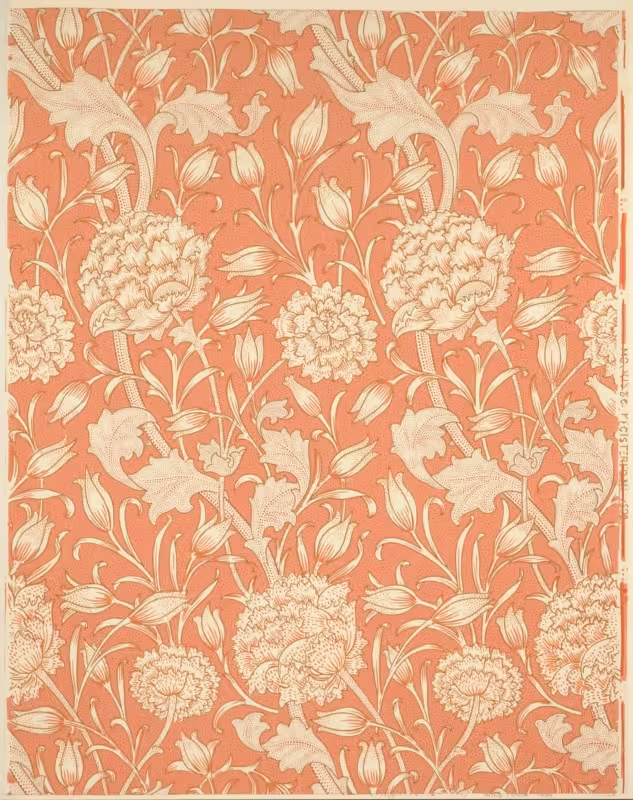
Wild Tulip turns a repeating pattern into a very lively patch of wall.
Some wallpaper politely stays in the background. This one has other plans. Cream-colored flowers crowd a coral-colored field, tulips lift their heads and curling stems keep the whole thing moving. William Morris called it Wild Tulip. The wall gets a garden, and nobody has to remember to water it.
The Metropolitan Museum of Art dates this design to 1884 and credits Morris & Company as manufacturer and Jeffrey & Co. as printer. It was block-printed in distemper colors. The museum connects its design to seventeenth-century Turkish brocades, a reminder that this English wallpaper has a wider visual ancestry.
Look past the biggest flowers for a moment. Smaller buds occupy the gaps, while pale leaves turn in different directions. The repeated stems give the eye a route through all that activity. Even the crowded parts have somewhere to go.
That is the pleasure of this particular sample: abundance with a structure you can follow. Cover part of the photograph, then look at the whole sheet again. A flower that seemed like the center turns out to be one stop in a continuing pattern.
For anyone collecting ideas for a room, the useful question is how much movement you enjoy living with. This wallpaper offers plenty. Start with the tulips, follow a stem and see where it takes you. The background has become the main event.
Explore the object: William Morris Lets the Wallpaper Do the Talking — The Metropolitan Museum of Art collection record.
Wild Tulip, 1884. William Morris. The Metropolitan Museum of Art, Purchase, Edward C. Moore Jr. Gift, 1923. Accession 23.163.4f. Image: The Metropolitan Museum of Art, Open Access, Public Domain / CC0. Collection record. Image use terms.

Source link
