
Pop/Hip Hop/R&B
Capygram – Pi Network 2.0? A Complete Review
Aug
★★★★★ 5/5 Stars
There was a time when the idea of earning cryptocurrency from a smartphone sounded almost too good to be true. Then came Pi Network, one of the most ambitious attempts to make crypto accessible to ordinary people by turning a mobile phone into the gateway to a digital economy.
Now, a new contender is taking that concept in a surprisingly different direction.
Enter Capygram.com.
At first glance, Capygram looks like another crypto-mining project. Look a little deeper, however, and a much bigger vision emerges: a social network, mobile mining ecosystem, entertainment platform, AI toolkit, virtual economy and growing collection of interactive applications—all wrapped around the Capygram token.
So, is Capygram the next Pi Network?
After exploring the platform and reviewing what it is building, our answer is:
It could be—and in some ways, it is attempting something even more ambitious.
What Is Capygram?
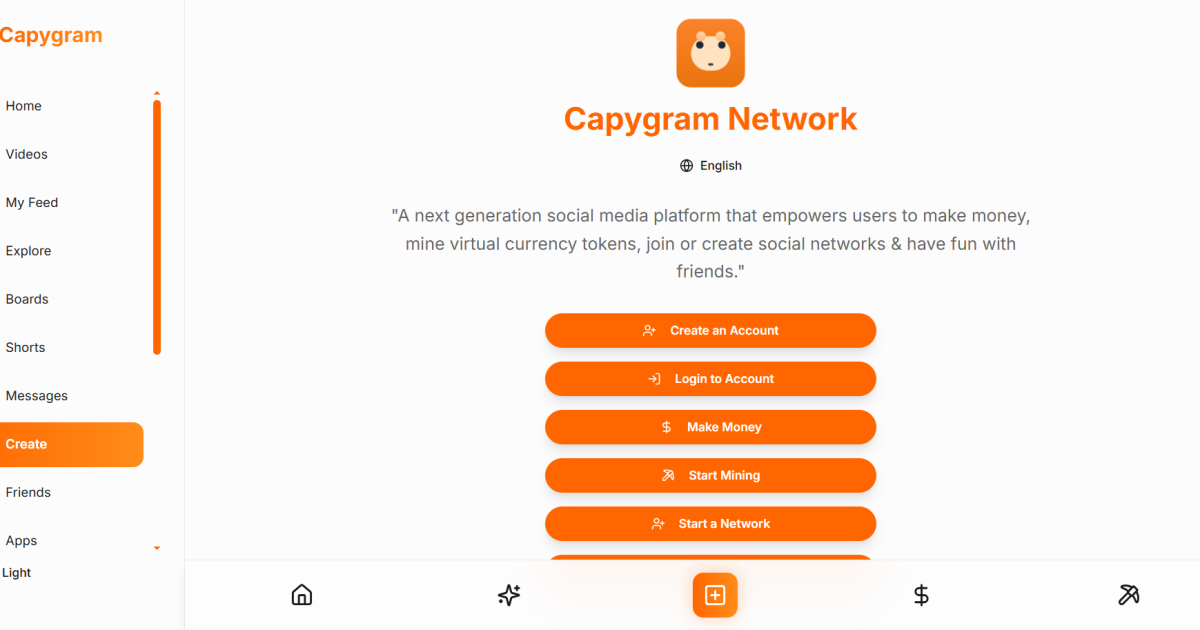
Capygram describes itself as a “next generation social media platform” designed to let users make money, mine virtual currency tokens, join or create social networks and have fun with friends.
That description is important because Capygram isn’t positioning itself simply as a cryptocurrency.
The bigger idea is an ecosystem.
Users can create an account, participate in mining, build referral networks, explore applications, interact socially and eventually participate in an expanding digital economy.
And that’s where the comparison with Pi Network becomes particularly interesting.
Pi’s enormous appeal came from simplifying cryptocurrency participation. Instead of requiring expensive mining hardware or advanced technical knowledge, Pi introduced an extremely accessible mobile-first experience.
Capygram takes a similar accessibility-first approach with CapyMining, allowing users to mine Capygram tokens through a phone or web browser. The platform says users can increase their mining power through referral networks and daily mining/check-in streaks.
The result is a concept that feels immediately familiar to anyone who has used Pi.
But then Capygram starts adding something Pi-like projects don’t always have:
Things to actually do.
⭐ The CapyMining Experience
The heart of Capygram is its mining system.
Rather than presenting cryptocurrency as something reserved for miners with powerful computers, Capygram puts mining directly into the user experience.
The platform says users can mine for free using either their phone or web browser. Daily participation and referral activity can increase mining power.
That is remarkably similar to the behavioral model that helped make Pi Network famous.
The genius behind this model is simplicity.
A traditional cryptocurrency mining operation might involve specialized hardware, electricity costs, wallets, exchanges, nodes and technical configuration.
A mobile mining ecosystem flips that equation.
Open the app. Participate. Return tomorrow. Build your network. Earn tokens.
Whether the long-term economics ultimately work is a separate question, but from a user-acquisition perspective, it is an extremely powerful concept.
And Capygram clearly understands that.
This is where the project gets considerably more interesting.
The Capygram homepage currently showcases a growing collection of applications covering cryptocurrency, artificial intelligence, metaverse experiences, productivity, creativity and entertainment.
There are already 18 highlighted applications on the platform’s homepage, with more available through its “Load more apps” functionality.
That’s a very different proposition from simply creating another mobile token.
Imagine combining elements of:
Pi Network + Facebook + Roblox + AI tools + casual gaming + a virtual economy.
That’s much closer to the Capygram vision.
🐾 CapyPets: Turning Crypto Into a Game
One of the more entertaining applications is CapyPets.
Users can adopt virtual pets—including dogs, cats, birds, rabbits and, naturally, capybaras.
They can feed their pets, upgrade their houses and build their virtual pet families.
This may sound like a simple game, but there’s an important strategic reason for including experiences like this.
Cryptocurrency ecosystems need reasons for people to return.
Mining alone creates a powerful daily habit, but games and social experiences can transform that habit into genuine engagement.
Instead of:
“I need to check my crypto mining.”
the experience becomes:
“I want to see what my virtual world is doing today.”
That’s a potentially much stronger retention mechanism.
CapyFood takes the virtual-economy concept another step further.
Users can create and operate virtual restaurants, design menus, set prices in tokens and earn when friends order food.
This is where Capygram starts to look less like a cryptocurrency application and more like a miniature digital economy.
The underlying concept is fascinating.
A user could potentially mine tokens, participate in applications, spend tokens inside virtual experiences and interact with other users.
That’s the type of circular economy that crypto projects have talked about for years.
The difficult part, of course, is building enough users and utility to make that economy meaningful.
But Capygram is at least attacking the problem from multiple directions.
Perhaps one of the most impressive aspects of Capygram is how heavily artificial intelligence is integrated into its application lineup.
CapyImageEditor is described as an AI-powered image editing tool capable of background removal, enhancement and creative edits using simple instructions.
Then there’s CapyToons, which transforms photographs into cartoon-style creations with options including anime, Disney, comic, sketch, watercolor and Pixar-inspired styles.
CapyStyles goes in a completely different direction, allowing users to virtually try on outfits using AI technology.
And CapyWriter provides an AI writing assistant designed for blogs, social media, emails, stories and other forms of content.
This is a particularly clever move.
AI tools give users a reason to visit Capygram even if they aren’t particularly interested in cryptocurrency.
Someone might discover the platform because they want to edit a photograph.
Another person might come for the AI writing tools.
Someone else might want to play chess.
Another user might be interested in virtual pets.
And another might come specifically to mine tokens.
Every application becomes a potential entry point into the larger ecosystem.
Capygram also appears to understand the importance of user-generated content.
CapyMemes allows users to create memes from templates, add their own text, share creations and browse a public meme gallery.
CapyPages lets users upload photographs and transform them into printable coloring-book pages.
CapyDesigns takes AI-generated creativity into the print-on-demand world, allowing users to design products such as T-shirts, posters, phone cases, stickers and mugs.
These features may seem disconnected at first.
They’re not.
Together, they create a content ecosystem.
Users don’t simply consume Capygram—they can potentially create things inside it.
That’s an important distinction.
Capygram even includes ChessPro, described as a multiplayer chess experience where users can challenge friends, choose different board styles and track player statistics.
This is another example of the project’s unusual breadth.
Instead of building one killer application, Capygram appears to be experimenting with an entire portfolio of applications.
Some will inevitably be more successful than others.
But the overall strategy is intriguing:
Build lots of reasons for people to stay inside the ecosystem.
The platform’s ambitions don’t stop with AI and casual applications.
Capygram also lists virtual homes and virtual cars.
CapyHomes allows users to browse, buy and manage virtual homes, while CapyCars focuses on exploring, purchasing and upgrading virtual vehicles.
This introduces another potential layer to the ecosystem: digital ownership.
Combine virtual property, virtual vehicles, virtual pets, restaurants, social networking and a token economy and you begin to see the broader vision.
Capygram isn’t simply trying to create a coin.
It’s attempting to create a digital world in which the coin has a purpose.
That distinction could become extremely important.
Perhaps surprisingly, Capygram also has productivity-oriented applications.
There’s CapyCalendar, which is positioned as a calendar application similar to Google Calendar.
There’s CapyQR, which allows users to generate customized QR codes.
CapyResumes lets users create stylish resume pages with custom URLs.
And CapyLinkInBio allows users to create customizable link-in-bio pages for platforms such as Instagram, TikTok and YouTube.
At this point, the pattern becomes obvious.
Capygram is trying to make the ecosystem useful for everyday digital activities—not just crypto speculation.
The comparison is absolutely justified—but “Pi Network 2.0” may actually undersell what Capygram is attempting.
Pi demonstrated that a cryptocurrency could attract enormous attention by making participation accessible to ordinary smartphone users.
Capygram borrows several ingredients from that playbook:
- Free, accessible mining
- Mobile participation
- Daily engagement
- Referral-driven growth
- A native token
- A community-oriented ecosystem
- An emphasis on accessibility
But Capygram adds another layer:
Applications.
Instead of asking users to simply accumulate tokens and wait for future utility, Capygram is building an ecosystem of games, AI applications, social tools, virtual experiences and productivity software around its network.
That’s the project’s biggest differentiator.
Of course, there is one enormous caveat.
A platform can have dozens—or even hundreds—of applications and still fail to create a sustainable economy.
The long-term success of Capygram will ultimately depend on several factors:
Real user growth.
Real application usage.
Token utility.
Network security and decentralization.
Sustainable token economics.
Developer participation.
And ultimately, whether people actually want to spend their tokens rather than simply accumulate them.
Those are questions that cannot be answered simply by looking at a website.
And this is where potential users should remain realistic.
Capygram’s impressive application lineup demonstrates ambition, but ambition isn’t the same thing as proven adoption.
The project still has to execute.
The easiest way to understand the difference is this:
| Feature | Pi Network | Capygram |
|---|---|---|
| Mobile-friendly crypto participation | ✅ | ✅ |
| Free mining concept | ✅ | ✅ |
| Referral incentives | ✅ | ✅ |
| Daily engagement | ✅ | ✅ |
| Social ecosystem | ✅ | ✅ |
| AI applications | Growing | ✅ |
| Games | Ecosystem-focused | ✅ |
| Virtual pets | Limited | ✅ |
| Virtual homes/cars | Limited | ✅ |
| Productivity tools | Ecosystem apps | ✅ |
| Meme/creative tools | Limited | ✅ |
| Broad built-in app ecosystem | Growing | Major focus |
Pi Network itself has also been expanding beyond mining, with its 2026 ecosystem updates emphasizing applications, utility, developer tools and products such as Pi Launchpad and Pi App Studio.
That means the two projects are actually moving toward similar territory.
The battle isn’t really “mining versus mining.”
It’s becoming a battle over who can build the most useful crypto-powered ecosystem.
Capygram earns 5/5 stars for vision, accessibility and sheer ambition.
What makes the platform exciting isn’t simply that users can mine a token.
It’s that Capygram appears to be attempting to surround that token with an entire ecosystem.
AI image editing.
AI writing.
Virtual pets.
Virtual restaurants.
Memes.
Chess.
Virtual homes.
Virtual cars.
Calendars.
QR codes.
Resume pages.
Link-in-bio tools.
Print-on-demand design.
And, at the center of everything, CapyMining.
That is an unusually ambitious combination.
Is Capygram guaranteed to become the next Pi Network?
Absolutely not.
No cryptocurrency project can guarantee that.
But does Capygram have the ingredients of a potentially fascinating Pi-style phenomenon?
Yes.
The most exciting part is arguably that it isn’t simply trying to replicate Pi.
It appears to be asking a bigger question:
What if a mineable cryptocurrency were connected to an entire digital lifestyle platform?
That’s the bet Capygram is making.
And if the team can turn its growing collection of applications into genuinely popular products, convert users into an active community and create meaningful utility for its token, Capygram could become much more than another mobile-mining experiment.
It could become a crypto-powered social and digital ecosystem in its own right.
For anyone fascinated by the evolution of accessible cryptocurrency, mobile mining and Web3 communities, Capygram is definitely a project worth watching.
Overall rating: ⭐⭐⭐⭐⭐ 5/5
Review based on Capygram’s publicly presented website and product descriptions as of August 2026. Features and project status can change as development continues. This review is not financial advice and should not be interpreted as a guarantee of future token value or investment performance.

Since 2005, Singersroom has been the voice of R&B around the world. Connect with us via social media below.
Source link
